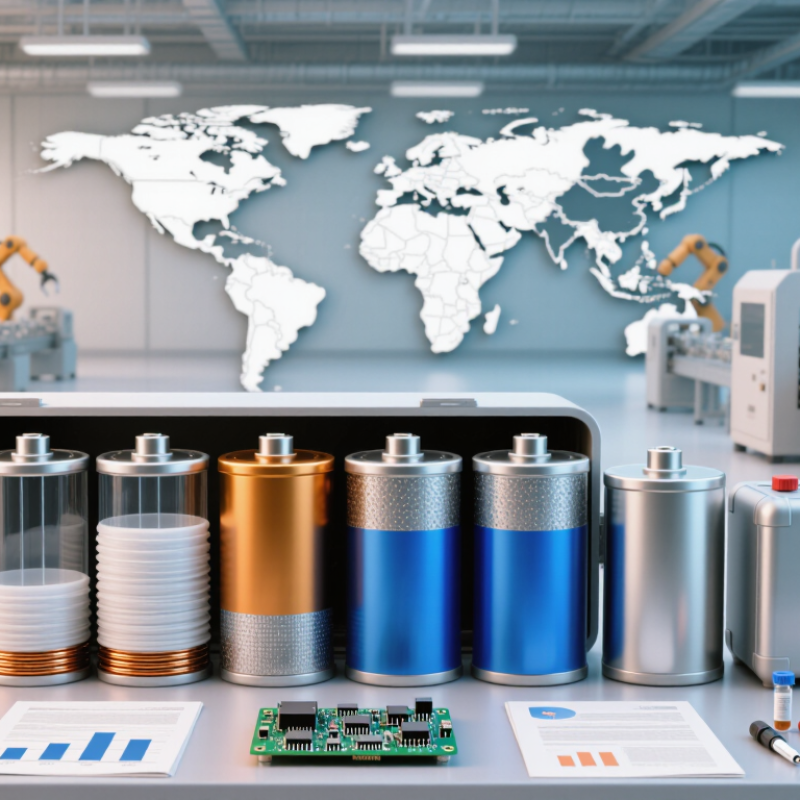
Where to Find China Top Li Ion Battery Components Suppliers?

Finding China’s top Li Ion Battery Components suppliers requires more than comparing prices or factory photos. A dependable supplier should show stable production, clear material specifications, batch traceability, and consistent test data. Key products include cathode and anode materials, separators, electrolytes, copper and aluminum foils, current collectors, battery cases, and protection components. Each part affects safety, cycle life, energy density, and manufacturing yield.

Professor Jeff Dahn, a respected lithium-ion battery researcher, has emphasized, “Safety is the most important characteristic of a battery.” His point should guide every supplier search. A supplier with impressive capacity may still struggle with moisture control, coating uniformity, or delivery consistency. Small weaknesses matter.

Look for suppliers with documented quality systems and relevant product certifications. Request recent inspection reports, sample batches, and technical data sheets. Ask how they manage raw-material changes and customer complaints. Visiting production lines in regions such as Guangdong, Jiangsu, Zhejiang, or Hunan can reveal details that online catalogs hide. Watch the warehouse conditions. Check packaging labels. Discuss failure analysis.

Price matters, but it should not lead the decision. A cheaper separator or electrolyte can create expensive delays later. This method is not perfect. Audits can miss problems, and polished presentations can mislead. Therefore, combine factory visits, independent testing, pilot orders, and contract controls. The best China supplier is not always the largest one. It is the partner that communicates clearly, proves consistency, respects applicable regulations, and improves when evidence exposes a weakness.

Where to Find China Top Li Ion Battery Components Suppliers?

Understanding China’s Li-Ion Battery Components Supply Chain

Where to Find China’s Top Li-Ion Battery Component Suppliers?

China’s lithium-ion battery supply chain is highly concentrated. The International Energy Agency’s Global EV Outlook 2024 estimates that China holds about 80% of global battery cell manufacturing capacity. It also controls most cathode and anode material processing. This concentration helps buyers compare cells, separators, copper foil, aluminum foil, and battery management parts within connected industrial clusters.

Look near Jiangsu, Zhejiang, Guangdong, and Fujian. These regions offer dense networks of material processors, precision manufacturers, testing laboratories, and logistics providers. The best supplier is not always the largest factory. Request production records, material certificates, sample data, and batch-level traceability. Check ISO 9001 systems and relevant IEC testing evidence. For vehicle applications, automotive quality controls deserve closer review. A polished website proves little.

Numbers can mislead.

BloombergNEF reported an average lithium-ion battery pack price of 115 dollars per kilowatt-hour in 2024, showing intense cost pressure across the industry. Low quotations may hide weaker coating uniformity, unstable moisture control, or limited after-sales engineering. Audit the drying rooms, inspect incoming-material controls, and compare three pilot batches. Also verify recycling and transport documentation. Supply chains change quickly, and even experienced buyers can overtrust a single factory visit. A reliable sourcing decision needs technical evidence, not only a favorable price.

Identifying Major Li-Ion Battery Component Categories

Where to Find China Top Li Ion Battery Components Suppliers?

Identifying major lithium-ion battery component categories makes supplier research more practical. The cell begins with cathode and anode materials, which influence energy density, cycle life, and safety. Separators prevent internal contact while allowing ion movement. Electrolytes carry ions between electrodes and require careful moisture control. Current collectors, usually metal foils, support electrical flow. Casings, tabs, and seals protect the internal structure from pressure, heat, and contamination.

A reliable sourcing process should separate material suppliers from precision component manufacturers. Ask for technical datasheets, batch records, dimensional tolerances, and safety test reports. Experienced buyers also compare moisture levels, coating uniformity, tensile strength, and resistance values. Factory audits can reveal storage problems that documents hide. I have found that sample performance may look excellent, yet production consistency remains uncertain. That deserves attention. Supplier capability should match the required cell chemistry, format, volume, and quality-control process.

Tips: Build a category-based supplier list before requesting quotations. Check whether each company produces, processes, or only trades components. Request recent samples from different batches. Test them under realistic temperature and charging conditions. Do not judge suppliers by price alone. A cheaper separator or electrolyte may increase rejection rates later. Keep communication records, approved specifications, and corrective-action details. Some decisions will need revision after testing, and that is normal.

Where to Find China Top Li-Ion Battery Component Suppliers?

Major lithium-ion battery components are evaluated by their typical share of cell material cost. Cathode materials usually represent the largest cost category, followed by anode materials, electrolyte, separator, current collectors, and casing.

Representative industry benchmark for a lithium-ion cell material-cost structure. Actual proportions vary by chemistry, cell format, raw-material prices, production scale, and supplier specifications.

Evaluating China’s Top Component Supplier Types

China’s lithium-ion supply base is not one supplier group. It is a layered market.

The IEA’s Global EV Outlook 2024 reports that China holds about 80% of global battery cell manufacturing capacity. That scale creates several supplier types, each requiring different checks.

Cell manufacturers offer integrated sourcing and production traceability. Material suppliers provide cathodes, anodes, separators, and electrolytes. Component specialists focus on battery management systems, current collectors, busbars, thermal pads, and safety vents. Equipment makers support coating, winding, formation, and inspection. System integrators combine several parts into modules or packs. Distributors may be faster for small orders, but their technical visibility can be weaker. BloombergNEF reported an average lithium-ion pack price of 115 dollars per kWh in 2024, showing how strongly cost competition affects supplier decisions. Low prices alone are not proof of quality.

Tips: Match the supplier type to your risk. Request batch records, cycle-life data, safety test reports, and sample-lot consistency. Confirm whether the factory makes components or only trades them. Visit production lines when possible. Ask for failure-analysis records, not only polished certificates. A neat supplier matrix can still mislead. I would score process control above the lowest quotation, especially for thermal and electrical components. The IEA also notes continuing supply-chain concentration, so maintaining a qualified second source is practical. It may cost more initially. That weakness deserves honest review.

Comparing Supplier Quality, Certification, and Production Capacity

Finding reliable Chinese lithium-ion battery component suppliers requires more than comparing quoted prices. Quality begins with controlled materials, stable dimensions, and documented testing. Ask for incoming inspection records, process-control charts, and batch traceability. A serious supplier should explain how it handles defects, not merely display attractive samples. Small details matter, such as separator alignment, terminal cleanliness, and connector contact resistance.

Certification provides useful evidence, but certificates need careful checking. Request current documents, testing scope, issuing laboratory, and matching product models. Standards such as ISO 9001, ISO 14001, IEC 62133, UN 38.3, and relevant safety approvals may apply differently. A certificate covering one component cannot automatically validate another. Verify laboratory reports directly when possible. Paperwork can look complete.

Production capacity should be proven on the factory floor. Review equipment lists, monthly output, staffing, maintenance records, and recent delivery performance. Ask whether capacity is reserved for your project or shared across many customers. Inspect automated inspection points and warehouse conditions. A supplier claiming large output but lacking traceability deserves caution. I have found that sample quality may exceed mass-production quality, so pilot orders and repeated inspections are necessary. No evaluation is perfect; even a strong audit can miss future material shortages or process drift.

Choosing Reliable Suppliers for Long-Term Battery Manufacturing

Where to Find China Top Li Ion Battery Components Suppliers?

Choosing a reliable supplier requires more than comparing cell prices. China remains central to battery manufacturing. The International Energy Agency reported nearly 80% of global battery cell manufacturing capacity was located there in 2023. Global electric vehicle battery demand also reached about 750 GWh that year (IEA, Global EV Outlook 2024). This scale creates choice, but not automatic reliability.

Start with verified factory evidence. Request recent audit reports, production-line photographs, process-control records, and traceability documents for cathode materials, separators, terminals, and protection components. Check whether the supplier controls critical processes or only resells parts. Ask for test data covering capacity retention, thermal performance, vibration, and cycle life. Small details matter. A clean sample may hide unstable batch control.

Long-term manufacturing needs measurable safeguards. Review ISO 9001 certification, incoming inspection procedures, failure-analysis methods, and change-notification rules. Confirm whether technical staff can explain tolerance limits without avoiding questions. The International Energy Agency also noted that battery manufacturing capacity greatly exceeded current demand in 2023, increasing competitive pressure across the supply chain. That pressure can encourage aggressive pricing. It can also weaken service after payment. A staged approval process is safer: sample testing, pilot orders, process audits, then volume contracts. Even this approach is imperfect. Certificates can expire, laboratory results may lack context, and delivery promises can change during raw-material shortages. Reliable sourcing depends on repeated verification, not one successful shipment.

Where to Find China Top Li Ion Battery Components Suppliers? - Choosing Reliable Suppliers for Long-Term Battery Manufacturing

Component Category Common Material or Chemistry Typical Commercial Specifications Key Quality Indicators Relevant Standards or Tests Supplier Verification Points
Cathode Materials LFP, NMC, LCO, or LMFP active materials Typical particle size: approximately 3–20 μm; nominal cell voltage commonly 3.2 V for LFP and about 3.6–3.7 V for NMC Specific capacity, tap density, moisture, residual alkali, particle-size distribution, metal impurity level IEC 62660 series; XRD, ICP-OES, Karl Fischer moisture, particle-size analysis, half-cell testing Request lot-level certificates of analysis, consistent batch records, traceability of precursor materials, and thermal-performance data
Anode Materials Natural graphite, synthetic graphite, or graphite–silicon blends Graphite theoretical capacity is 372 mAh/g; commercial anode formulations are commonly designed around 330–365 mAh/g reversible capacity First-cycle efficiency, reversible capacity, expansion, tap density, surface area, moisture, and rate capability IEC 62660 series; coin-cell cycling, BET surface-area testing, particle-size analysis, expansion and adhesion tests Check consistency across lots, silicon content disclosure, coating compatibility, and long-cycle data at the intended charge rate
Separator Film Microporous polyethylene, polypropylene, or multilayer polyolefin film Typical thickness: 7–20 μm; porosity often about 35–50%; shutdown behavior commonly occurs near the melting range of the polymer layer Thickness uniformity, puncture strength, tensile strength, porosity, air permeability, shrinkage, and electrolyte wettability IEC 62660; ASTM or ISO methods for tensile strength, puncture resistance, shrinkage, thickness, and air permeability Audit coating uniformity, clean-room controls, roll-to-roll inspection, edge quality, and storage humidity controls
Electrolyte Lithium hexafluorophosphate salt in carbonate solvents with functional additives Common salt concentration: approximately 0.8–1.2 mol/L; water content is normally controlled at very low ppm levels Ionic conductivity, water content, acidity, density, conductivity retention, gas generation, and compatibility with electrode chemistry IEC 62660; Karl Fischer moisture testing, conductivity testing, gas analysis, and abuse-performance evaluation Verify sealed packaging, batch traceability, shelf-life data, transport classification, and documented moisture-control procedures
Copper Foil Electrolytic copper current collector for anodes Common battery-grade thickness: 6–10 μm; wider and thicker grades are also used for high-power applications Thickness variation, tensile strength, elongation, surface roughness, pinholes, oxidation, and edge quality ASTM B152/B152M and customer-specific battery-foil specifications; surface and mechanical inspection Request width tolerance, roll-length control, defect maps, surface-treatment details, and packaging protection against oxidation
Aluminum Foil Battery-grade aluminum current collector for cathodes Typical thickness: approximately 12–20 μm; alloy and temper depend on the cell design Thickness uniformity, tensile strength, elongation, surface cleanliness, pinholes, and coating adhesion ASTM B209/B209M and customer-specific foil requirements; mechanical, dimensional, and surface inspections Confirm alloy composition, roll traceability, coating adhesion performance, slit-edge quality, and moisture-resistant packaging
Battery Management System Cell-monitoring ICs, protection circuits, current sensors, communication interfaces, and balancing circuits Typical cell-voltage measurement accuracy: approximately ±5–20 mV, depending on the design and operating conditions Overcharge, over-discharge, overcurrent, short-circuit, thermal protection, balancing accuracy, SOC estimation, and communication reliability IEC 62619, IEC 62133-2, UL 1973, ISO 26262 where applicable, EMC and environmental testing Review firmware change control, fault-injection results, calibration records, cybersecurity provisions, and end-of-line test coverage
Cell Casing and Covers Aluminum or steel cans, pouch laminates, covers, vents, and sealing components Material and dimensions are application-specific; pouch laminates commonly use polymer, aluminum, and sealant layers Dimensional accuracy, weldability, corrosion resistance, sealing strength, insulation, and vent performance IEC 62133-2, IEC 62619, UL 1642, leak testing, burst testing, weld-strength testing, and dimensional inspection Check tooling capability, cavity-to-cavity consistency, sealing-window validation, leak-rate limits, and long-term corrosion data
Tabs and Insulation Parts Nickel-plated steel, aluminum, copper, polyimide, PET, PP, and other electrical-insulation materials Thickness, width, and weld area are selected according to current load, cell format, and thermal design Electrical resistance, weld strength, insulation resistance, dimensional stability, burr control, and heat resistance IEC 62133-2, UL 94 for flammability where applicable, insulation-resistance and weld-pull tests Validate welding-process windows, material certificates, insulation thickness, burr limits, and automated visual inspection
Thermal Interface Materials Thermal pads, phase-change materials, gap fillers, adhesives, and electrically insulating compounds Typical thermal conductivity: approximately 1–8 W/m·K for many commercial battery-pack interface products Thermal resistance, compression set, dielectric strength, adhesion, outgassing, aging, and flame resistance ASTM D5470, UL 94 where applicable, thermal cycling, humidity aging, dielectric-strength testing Request application-specific thermal data, compression curves, shelf-life information, lot traceability, and validated dispensing or assembly parameters
Data note: The specifications shown are representative commercial ranges and common industry practices. Final requirements should be confirmed against the target cell chemistry, form factor, operating conditions, certification plan, and production process.
Top