
Choosing an Off Road Dump Truck in 2026 starts with the job, not the brochure. A 40-tonne payload may suit a compact quarry, while a large open-pit mine may need a much heavier machine. The U.S. Geological Survey’s Mineral Commodity Summaries 2025 estimates global copper mine production reached about 23 million metric tons in 2024. That scale makes haul-road capacity, cycle time, and fleet availability practical selection questions—not minor details.
Payload is not productivity. Caterpillar lists the 797F at a nominal 363-metric-tonne payload, but that figure alone cannot predict daily output. Match truck capacity to the loading tool, haul distance, gradients, road conditions, and planned operating hours. Then compare fuel or energy use, tire costs, service access, parts support, and operator visibility. A truck that looks efficient on paper may lose time on a soft, rutted road or while waiting for a compatible loader.
W. Edwards Deming, a quality-management expert whose data-first principle applies to fleet decisions, is often quoted as saying, “In God we trust; all others must bring data.” Treat that as a useful test: ask suppliers for duty-cycle assumptions and validate them against site records. For a credible comparison, review payload, fuel consumption, availability, and maintenance data under the same operating conditions. One caution: published figures are not guarantees. Real sites differ, and even a careful selection can miss something. The best choice is the truck that safely and reliably moves the required tonnes at an acceptable cost over its working life.
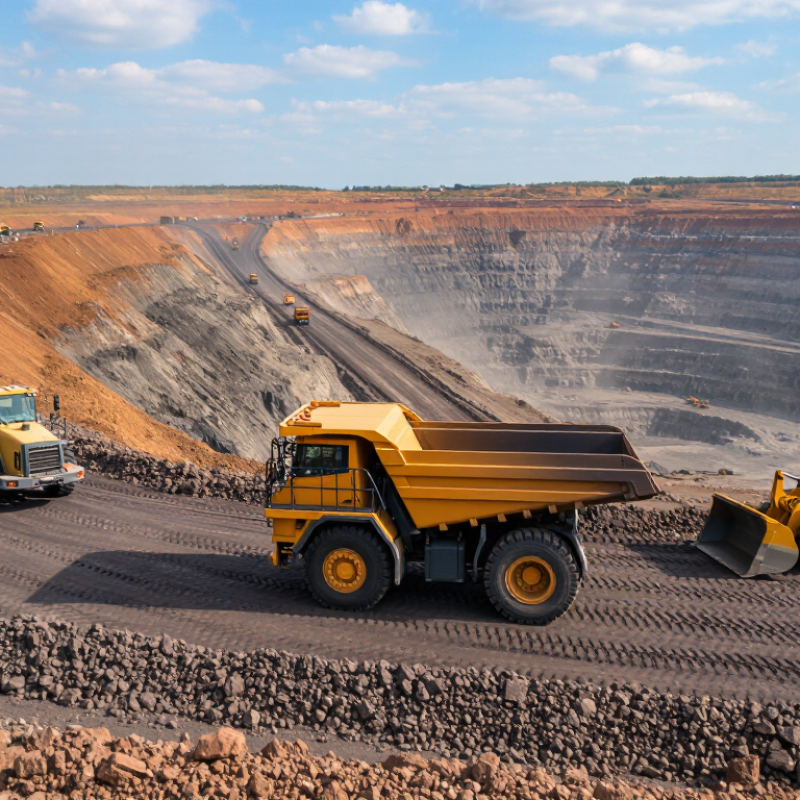
Choosing an off-road dump truck starts with the job, not the payload number on a brochure. Record the material, average load, haul distance, and daily cycle count. Loose overburden behaves differently from wet clay or sharp blasted rock. A truck that moves gravel efficiently may struggle when sticky soil clings to its body. Be specific.
Walk the route after rain, not only on a dry inspection day. Note the steepest grade, tightest turn, soft shoulders, and narrow loading areas. Measure road width and check whether loaded trucks can pass safely. Ground clearance, traction, braking capacity, and tire choice should match these conditions. Small details matter. One muddy bend can dictate more than the site’s average slope.
Estimate operating conditions over a full shift. Consider temperature, dust, elevation, idle time, and access to fuel, service, and replacement tires. These factors affect cooling, filtration, uptime, and support needs. Compare expected payload with cycle time and road capacity; a larger truck is not automatically more productive. Ask operators and maintenance staff what fails or slows down on this site. Their notes may be imperfect, but they often reveal overlooked costs. Recheck assumptions with a loaded trial when possible.
Choosing an off-road dump truck starts with the material, not the machine’s largest advertised payload. Wet clay, blasted rock, and loose sand load differently. A bucket that looks full can still leave the truck underloaded, while dense rock may reach the weight limit before the body is full. Check typical material density and moisture at the site, then compare them with the truck’s rated payload and body volume.
An articulated truck often suits rough, winding routes and soft ground. Its maneuverability can help when loading areas are tight. A rigid-frame truck may carry more per trip on firm, well-maintained haul roads. That difference matters over distance. For long hauls, higher payload can reduce trips, but only if the road, grades, and turning areas support the truck safely. Measure the route, including steep sections and seasonal surface changes.
Payload is only part of the calculation. Estimate cycle time: loading, travel, dumping, and return. A smaller truck making steady trips may outperform a larger one waiting at a narrow loading face. Small details count. Compare the planned load with actual scale weights during early shifts, and watch for spillage or uneven loading. I would not trust a single day’s figures; moisture and road conditions can shift quickly. The right match may be less obvious than the specification sheet suggests.
| Truck Type | Typical Payload Range | Suitable Materials and Work | Indicative One-Way Haul Distance | Best-Fit Conditions | Key Selection Consideration |
|---|---|---|---|---|---|
| Articulated dump truck (ADT) | Approximately 25–45 tonnes | Overburden, blasted rock, soil, clay, and mixed construction material | About 0.5–5 km on variable or rough haul roads | Soft, uneven, wet, or winding routes; changing work areas; moderate haul distances | Articulation and all-wheel drive help maintain mobility on rough ground. Compare loaded-cycle time and fuel use with a rigid truck on firm, well-maintained roads. |
| Rigid-frame off-highway truck | Approximately 40–100 tonnes in common mine and quarry classes | Blasted hard rock, ore, aggregate, and other dense bulk materials | About 1–8 km on engineered mine or quarry roads | High production on stable, wide haul roads with consistent loading and dumping points | Match payload to the excavator or loader and road design. Larger capacity is not beneficial if the truck is underloaded or the route cannot support its operating weight. |
| Large rigid mining truck | Approximately 100–400 tonnes, depending on truck class | High-volume ore, waste rock, and overburden in large open-pit operations | About 2–10 km on purpose-built mine haul roads | Very high, steady production with large loading units, broad roads, and established maintenance support | Assess total cost per tonne, road width and grade, loading-unit match, and availability of service infrastructure—not payload alone. |
| Compact site dumper | Approximately 1–10 tonnes | Soil, sand, gravel, and general construction materials in smaller quantities | Usually under 1 km on construction or landscaping sites | Confined sites, short cycles, narrow access, and frequent maneuvering | Check overall width, turning space, ground pressure, and whether the chosen body configuration suits the material. |
| Underground mining truck | Approximately 15–65 tonnes | Underground ore and development muck | Route-dependent; typically selected for underground circuits rather than a fixed surface-haul distance | Low-profile headings, restricted turning areas, and underground loading and dumping points | Prioritize vehicle dimensions, turning radius, ventilation requirements, ramp grade, and compatibility with underground loading equipment. |
Planning note: Payload ranges and haul distances are indicative industry-level guides, not model specifications or universal limits. Confirm actual payload, material density, route length, grade, road condition, cycle time, and legal or site requirements before selecting a truck. Avoid exceeding rated payload, and evaluate the complete loaded and empty haul cycle.
How to Choose an Off Road Dump Truck in 2026?
Compare Powertrain, Tires, Braking, and Maneuverability
Match the powertrain to the loaded route, not the brochure’s peak horsepower. Record cycle times on the steepest grade and note engine response during starts. For a regulatory benchmark, U.S. EPA Tier 4 final standards set limits of 0.4 g/kWh for NOx and 0.02 g/kWh for particulate matter in the 130–560 kW engine class. These figures measure emissions, not pulling ability. Ask for duty-cycle fuel data, too.
Tires determine grip, flotation, and how quickly heat builds on rough ground. Check the published load-and-inflation tables against actual payload, then inspect for cuts after a representative shift. Dust matters. Compare service-brake stopping distance on the same loaded descent, and check whether an auxiliary retarder can control speed without repeated hard braking. Record brake temperatures if available; one short test may miss fade after several runs.
For maneuverability, measure turning radius and swept path in the tightest real loading area. A truck that turns neatly on paper may still need extra reversing space beside a berm or shovel. I would compare the same route, load, and operator across candidates; otherwise the numbers can mislead. The awkward detail is that the easiest truck to steer may not carry the most per trip.
Compare powertrain, tires, braking, and maneuverability across common truck configurations.
Representative class-level benchmarks: payload and engine power vary by model and duty cycle. Use them for initial comparison, then verify manufacturer specifications. Match powertrain and tire setup to terrain and load; check braking performance for loaded descents and turning radius for site access.
Safety systems deserve a field test, not a brochure check. Confirm that the cab’s rollover protection, seat belt, cameras, and alarms suit your routes and loading areas. BLS recorded 1,075 fatal work injuries in construction in 2023. That figure is not specific to dump trucks, but it shows why visibility and operator protection matter. Walk around the truck from the driver’s seat. Can the operator see a ground worker near the rear wheels? A clean brochure proves little.
Reliability depends on more than engine hours. Deloitte has estimated that unplanned downtime costs industrial manufacturers about $50 billion each year; treat this as context, not a truck-fleet forecast. Ask for maintenance records, component service intervals, and typical repair times. Then check whether filters, grease points, and inspection areas are reachable after a muddy shift. Can local technicians access diagnostic information and obtain common parts quickly? Mud is the audit. A truck may look easy to service on a dry lot, yet feel different in a tight field workshop. Leave room for that uncertainty when comparing options.
Choosing an off-road dump truck in 2026 starts with the rules at your actual worksite. Requirements can vary by region, vehicle class, and job type. Check current emissions, noise, weight, and site-access requirements with the relevant authority before comparing machines. A truck that looks suitable on paper may not fit a narrow haul road or steep, muddy grade. Measure turning areas and check payload needs against the ground conditions. Small details matter.
Compare total cost, not just the purchase price. Estimate fuel use across typical shifts, tire replacement, scheduled servicing, and likely repair delays. Ask for written service intervals and warranty terms, then check whether common parts are stocked nearby. Dealer support is practical evidence: response times, technician availability, and access to service records matter when a truck is down. Get specifics. Still, forecasts are imperfect; actual costs depend on loads, terrain, and operator habits.
Tips: Visit the dealer with your route data and ask for a demonstration on similar terrain. Inspect cab visibility, steps, and controls in person. Request a sample maintenance schedule and a clear estimate of expected annual costs. Compare support commitments in writing, and verify that the proposed configuration meets the rules where it will work. Don’t overlook operator feedback; a brief test may not reveal every drawback.